Start with Assessment
IDEA and state regulations remind us that in education we always start with assessment or evaluation. Dr. Nielsen developed a comprehensive tool, called “Functional Scheme”, which can help your team to develop a clear picture of the child’s current levels of performance in twenty different areas of development from birth thru 48 months (4 years).
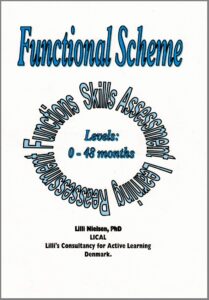
We strongly recommend that the team complete a Functional Scheme assessment as a first step. You can learn more about this tool and how to use it in the following ways:
- Explore the Assessment section of Active Learning Space
- Watch these Active Learning Study Group webinars:
- September 2015
- December 2015
- January 2016
- March 2016
- May 2016
- Get a copy of Functional Scheme and review it.
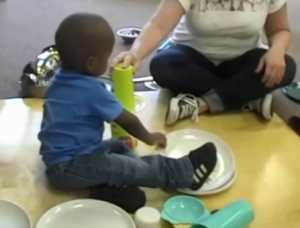
It is important to note that the completion of the Functional Scheme cannot be (or should not be) completed quickly, especially the first time the student is assessed using this tool. You will need time to talk to the parents and caregivers, observe the child in a variety of settings during independent and interactive play, and have various team members collaborating to discuss the impact of sensory impairments on development, especially in light of other medical conditions or additional disabilities. It may be helpful for different specialists to take the lead on various sections, such as the PT, OT, SLP, TVI focusing on gross motor, fine motor, communication, vision, etc.
While Assessing, Start Implementing
In light of the fact that the initial assessment may take some time, do you wait until it is complete to even before starting to use an Active Learning approach? NO! In fact, you will find that you may need to start trying some Active Learning strategies in order to be able to complete the assessment accurately, especially if you are not very familiar with the child. But, where do you begin?
What the Adult Should Do
It is very important to remember that these learners are at a developmental level of sensorimotor (birth-2 yr.) or early pre-operational level learners (2-4 yr.) and they will learn differently than a child who is developmentally older. This is a basic of human development.
So before you go further, begin by reviewing the Principles of Active Learning section including:
- Dynamic Learning Circle
- Pathways to Learning
- Social and Emotional Development
- Five Phases of Educational Treatment
Then you can begin to set up environments for independent and interactive play to observe the student. If you have some of the Active Learning equipment on hand, you may want to try it out with the student, but make sure you know how to select and set up the equipment for safety and at the level of the child’s current skills as best you can. Check out the information under the Equipment section.
However, Dr. Nielsen often used some very inexpensive items (many of which can be homemade) to learn about the child’s likes and dislikes, preferred sensory channels for learning, how the child makes contact with others, and his or her emotional developmental level. We often recommend using a Resonance Board, a large number of attractive objects, and the treatments of Offering (Phase 1), Imitation (Phase 2), and Interaction (Phase 3) if appropriate, with the child. You can also observe the child interacting with objects alone to see what you observe. Think about recording these sessions and/or having multiple team members observe and take notes about what they see.
As a way to capture your notes and guide your observation, we suggest you use the Active Learning Materials and Activities Planning form. The “Questions” section can be especially helpful during your observations.
What Equipment and Materials Should We Try?
Choosing the appropriate equipment and materials for a learner requires some thought. The Active Learning Materials and Activities Planning form will help you get some basic information together to begin to make good choices.
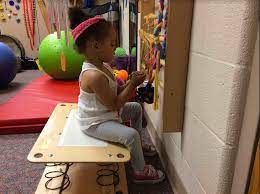
Once you know what the child likes and what is aversive, what his or her preferred sensory channels are for learning, and have considered what skills you can observe the student currently using, you can get started.
Review the general guidelines for selecting materials and equipment. You may also want to download Quick Guide to Active Learning Equipment (Word or PDF). It is very important to consider the size of the learner overall, and especially the size of the hands in selecting many of the materials. Don’t worry if you get things that don’t interest the child or don’t work for some reason…this is important information about the child’s preferences and skills. Just be sure to make note of what works and what doesn’t. Ready to Implement Active Learning?
Assuming you have made inroads into the assessment of the learner and begun to try out some of the Active Learning materials and equipment, you should know enough to develop the student’s daily program.
Goals and Objectives are the Focus
It is critical to know what goals and objectives you are focusing on with the learner because Active Learning means PURPOSEFUL play. The equipment and materials you choose in your environments help the child learn in the same way a textbook or software program might be selected for a more typical learner. Whether you focus on instruction in the standard curriculum or expanded core curriculum, you can use an Active Learning approach for instruction. To learn more about this, check out this information:
Organize the Day
Dr. Nielsen reminds us that to learn we have to be active. For this reason, she suggests alternating between gross and fine motor activities throughout the day. She also recommends a minimum of 30-45 minutes each day spent in adult-child interactions. Look at the student’s current schedule and see if you have this type of schedule. Take time to figure out where you can make changes with support from a paraprofessional or related service staff to organize the day in this fashion. If you need ideas for activities, you can look in the FIELA curriculum developed by Dr. Nielsen.
You may also want to review the pages in the Implementation section to get some other wonderful ideas about using Active Learning in your classroom.
Organize Your Classroom
An undeniable fact about Active Learning is that it requires a lot of “stuff”, so where do you put it all? How can you possible organize your classroom so you can have everything you need for the Active Learner and everyone else? To get some ideas that may help you we suggest you check out Setting Up Your Classroom.
Track Progress, Re-Assess, Make Changes
Once you start implementing Active Learning, you will gain a great deal of insight into your student, especially if you keep good documentation. There are a variety of ways to do this, and many different people have created forms for this purpose. Select the form(s) that will work best for you. Here are a few that may help to get you started:
- Active Learning Skills Checklist
- Documenting Progress on Goals-Objectives Form
- Essef Board Observation Form
- HOPSA Dress Observation Form
- Little Room Observation Form
- Multi-Functional Activity Table Observation Form
- Support Bench Observation Form
- Other Perceptualizing Aids Observation Form
Another way to go is simply to list the specific IEP goals and objectives that are being worked on in each activity or environment with a simple plus (+) or minus (-) notation if the student meets the objectives or benchmarks. Of course, you need to be sure the goals and objectives reflect any new information you have discovered through the process of assessment.
We also recommend regular re-assessment using the Functional Scheme, as it is a perfect way to document progress, especially for the longer reporting segments (e.g. 6-weeks report cards). At regular intervals, update your original assessment and use the various columns of the Functional Scheme to note such things as “learning has begun”, “performs in favorable conditions” or “performs spontaneously.”
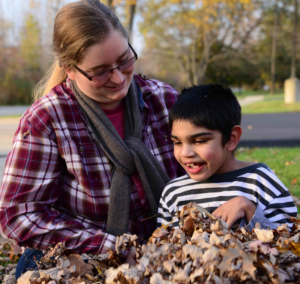
You may also want to use photographs and videos as part of a portfolio to supplement any other documentation you acquire. Be sure to invite input and examples from the family since they are likely to see some skills at home that you do not observe and vice versa.
Don’t forget, Active Learning is dynamic so what is working well for the child today may not work tomorrow. The whole point is for the child to learn and grow. Be sure to make changes (small and gentle) to activities and environments as the child reaches Stage 3 of the Dynamic Learning Circle (completion of learning or habituation) so he or she does not become stuck. Look for signs that changes need to be made by reviewing the “When Things Go Wrong” page.
Remember that the child is a child is first and learning should be fun!